ESAF Foundation Communications
7 June 2025
FEATURE
Solar Energy Finds Its Champions in Small Towns
ESAF Foundation Communications
7 June 2025
This feature explores how ESAF Foundation’s Urjabandhu programme transforms rural electricians into solar professionals. By linking skills, markets, and clean energy, it creates dignified livelihoods, reduces emissions, and anchors climate action in the hands of those once left behind.
In the quiet lanes of Aruppukottai in Tamil Nadu, under a punishing sun, a young man named Velmurugan used to spend his days fixing wiring faults and battling the seasonal unpredictability of contract work.
Some days brought a little extra. Most, just enough. There was pride in the work, yes, but no certainty, no path, no spark.
Today, Velmurugan is not just an electrician. He is an Urjabandhu—an ally of energy.
His name now appears in the phonebooks of local temples, schools, and small factories. His tools no longer just repair electricity; they create it.
Rooftops became his canvas. Solar panels, his script. And his story, like dozens of others, is a story of local power, literal and metaphorical.
The Case for Clean Energy
India is the world’s third-largest energy consumer, but still, much of its power grid runs on the past. Fossil fuels, especially coal, remain the dominant source. As the country builds, expands, and dreams bigger—urbanising at breakneck speed and industrialising across states—its energy appetite is set to double by 2040 (Mint, 2021, February 9). Unless this growth is rerouted, the price could be steep: skies choked with smoke, lungs burdened with toxins, and a carbon trail that scorches an already fragile planet.
And yet, a different kind of power rains down on India almost every day. For 250 to 300 days a year, the subcontinent basks in sunshine—radiant, relentless, and free. This sunlight translates into an estimated 5,000 trillion kilowatt-hours of potential solar energy annually, which is more than enough to meet all of India’s energy needs. Most regions receive 4 to 7 kilowatt-hours per square metre each day. A clean, zero-emission fuel that could electrify villages, decongest cities, and unshackle grids from their fossil-fuel chains. With a booming tech sector and millions of rural hands ready to work, solar energy is not merely a climate fix—it is India’s quiet superpower (Invest India, 2021, July 1).
And the government knows it. India has pledged to install 500 gigawatts of non-fossil fuel capacity by 2030 and to reach net zero emissions by 2070 (Ministry of Environment, Forest and Climate Change, 2023, August 3). These are declarations of intent, written under the harsh spotlight of climate urgency. But they cannot succeed on ambition alone. They need hands. They need rooftops. They need boots in the dust and tools in the sun. They need people like Velmurugan, the Urjabandhu from Aruppukottai, whose fingers now thread the nation’s energy future panel by panel.
Launched in 2021, as part of ESAF Small Finance Bank’s CSR initiative, Urjabandhu is one such spark—grounded, grassroots, and quietly radical. It is aligned with the United Nations’ Sustainable Development Goals (SDGs), particularly those addressing renewable energy and decent livelihoods. At its heart lies a deceptively simple but transformative idea: train local hands to build local energy.
In 2025, Urjabandhu was recognised with the Most Impactful Solar Energy Initiative of the Year—a golden feather not just in ESAF Foundation’s cap, but in the shared pride of every young person who took a leap of faith into the light.
Projects like Urjabandhu stitch national targets to real lives. They carry solar to sloped tin roofs and modest courtyards. They turn young electricians into entrepreneurs. They bring jobs to towns where the only option used to be leaving. And they restore something deeper—energy independence in homes where electricity still flickers like a candle in the wind.
Solar Skills, Local Livelihoods
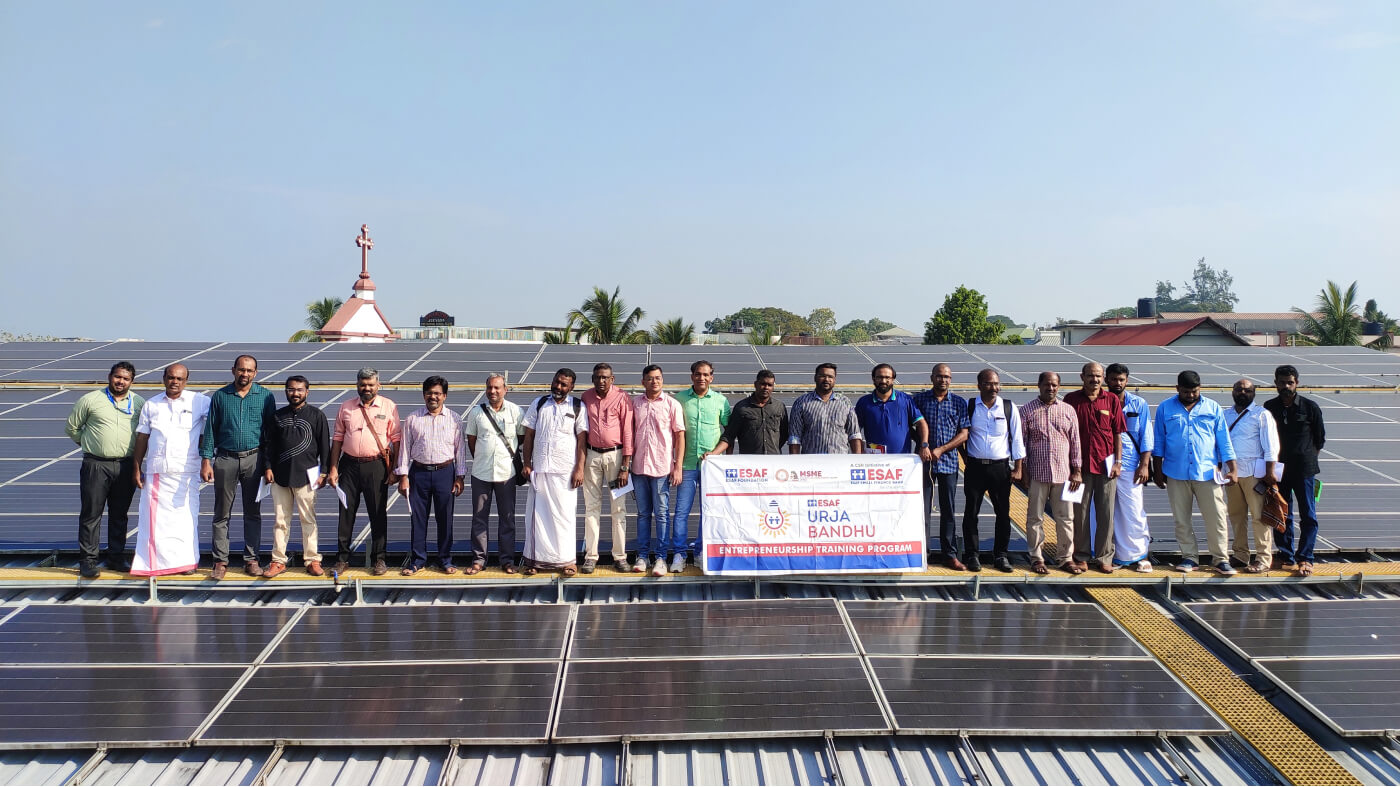
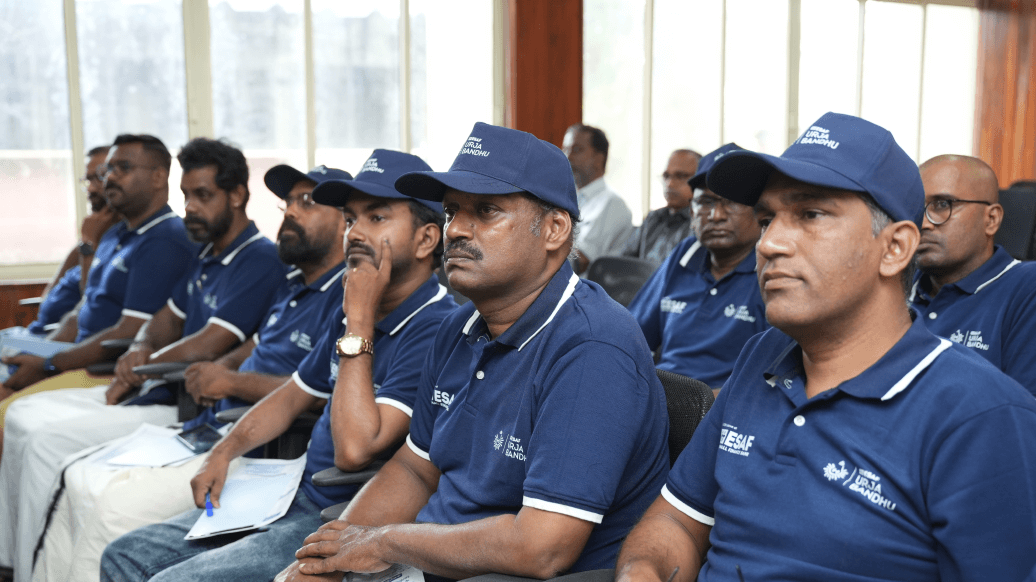
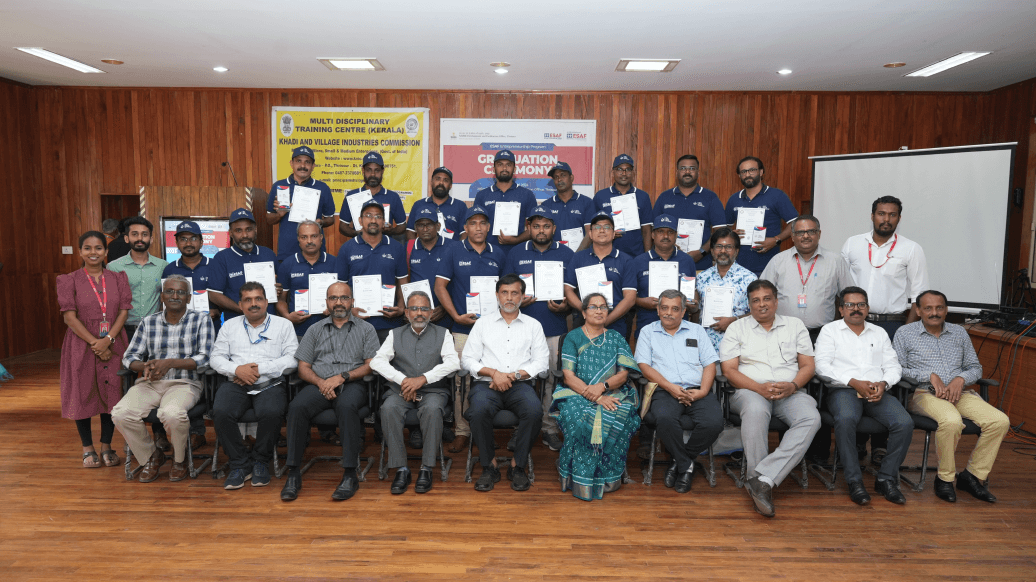
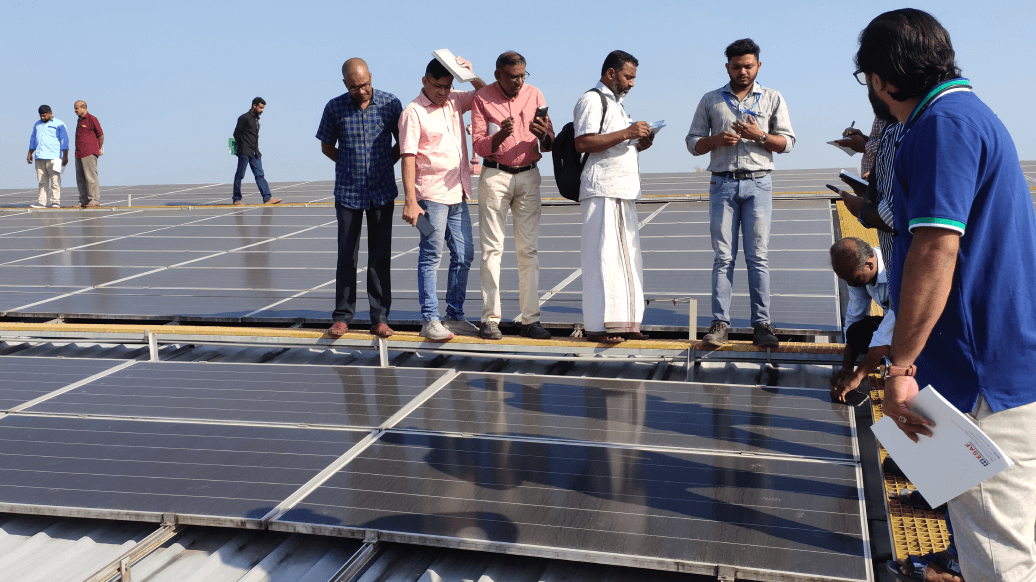
The training is intense, immersive, and hands-on. Over five residential days, aspiring solar entrepreneurs are guided through everything from PV system design and installation to government subsidies and market compliance. Instructors certified by the Ministry of MSME and the Renewable Energy Centre—Mithradham—teach not just how to fix a circuit, but how to build a future.
But what makes Urjabandhu transformative is what happens after the classroom. ESAF Foundation ensures market access. It opens doors to financing. It follows up with advanced sessions on branding, compliance, and customer trust. These young men, many from diploma or ITI backgrounds, are no longer just service providers. They are business owners, complete with GST numbers, MSME registrations, and, most importantly, clients who return.
Across Kerala and Tamil Nadu, nearly 300 Urjabandhus have been trained. Together, they have installed 10 megawatts of rooftop solar capacity—enough to power entire towns. Every day, their work generates 40,000 units of clean electricity.
Each rooftop they wire captures more than sunlight. It cuts carbon. It lowers bills. It changes lives. So far, they have kept over 12,000 tonnes of CO₂ out of the atmosphere annually and saved families and businesses more than ₹10 crore in electricity costs.
And in the process, they have created over 30,000 man-days of local employment. Most of it in towns like Velmurugan’s, where work usually means packing a bag and leaving home behind.
Each Urjabandhu now earns between ₹15,000 and ₹21,000 a month. Some earn more. A few have become employers in their own right. And their impact has not gone unnoticed—at least 20 have secured formal MSME registrations, anchoring their ventures in long-term sustainability.
The Groundwork That Made It Possible
Urjabandhu did not spring out of nowhere. It grew from years of patient groundwork—ESAF Foundation’s long-standing commitment to clean energy, especially among women and marginalised households across rural India.
In partnership with the FMO (Entrepreneurial Development Bank), ESAF Foundation led one of the country’s largest grassroots awareness campaigns on clean energy. Through 11,782 SHG meetings in six states, more than 2.6 lakh women were introduced to a new kind of toolkit—solar lanterns, efficient cookstoves, and water purifiers. These were not just products. But promises of safer homes, healthier families, and greater autonomy.
In 2019–20 alone, 86,836 families received solar lights, eliminating the need for 10.4 lakh litres of kerosene. Water purifiers brought clean drinking water to more than 2,000 people. Improved cookstoves reduced over 11 tonnes of firewood use—a quiet revolution in kitchens where smoky air once clung to walls and lungs.
But the ESAF Foundation’s approach was never about handing things out. It was about handing over power. It focused on informed choices, technical guidance, and household ownership. With support from partners like JRR Solar Tech, rooftop solar and inverter pilots began rolling out, until over ₹123 crore worth of clean energy products had been promoted in a single phase.
The ESAF Foundation did not stop at impact. It demanded proof. Through a partnership with MicroEnergy Credits, the Foundation registered its micro-energy initiatives under the UNFCCC for carbon audits. By March 2020, the numbers told their own story: over 4.3 lakh tonnes of carbon emissions averted. The project received a 99.98% institutional rating and an 88.54% project score—a quiet affirmation that precision and purpose can indeed walk hand in hand.
A Future Wired Locally
What connects those early awareness drives to today’s rooftop installers is a live current: local empowerment.
Today, as Velmurugan climbs roofs in Aruppukottai, he stands on the shoulders of a decade of ESAF Foundation’s investment in skill, in trust, and in the belief that climate action begins not in boardrooms, but at the margins.
As for Velmurugan, he dreams of expanding beyond Aruppukottai. He is training his cousin. His mother, once anxious about his unstable earnings, now proudly says her son powers the temple. And in the narrow streets he grew up in, young boys still stop to watch when his motorbike rolls past, with solar panels strapped like wings to the backseat.
This is what clean energy looks like, not in theory, but in action. Not as a distant policy, but as livelihood, dignity, and ownership. Urjabandhu is no longer just a project. It is a platform. It is a profession. One that lifts people from precarity into pride.
And in the lanes where the sun once only scorched, it now powers.
References
Mint. (2021, February 9) India to be largest source of energy demand growth to 2040 – IEA Retrieved from https://www.livemint.com/news/india/india-to-be-largest-source-of-energy-demand-growth-to-2040-iea-11612853148055.html
Ministry of Environment, Forest and Climate Change. (2023, August 3) Press Information Bureau, Government of India. Retrieved from https://www.pib.gov.in/PressReleaseIframePage.aspx?PRID=1945472
Invest India. (2021, July 1). India’s rising solar sector. Retrieved from https://www.investindia.gov.in/siru/indias-rising-solar-sector